

Materials
I often get asked about the materials I use to create my paintings, and I'm just as interested in what other artists choose to work with.
Over the years, I've spent a lot of time trying different paints, papers and brushes to find the combinations that give me the results I'm looking for. For me, it's important that my materials are reliable and work well with the way I paint.
I now use high-quality materials throughout my work. Good watercolour paper, paint and brushes really do make a difference, and I've found that using materials I can rely on allows me to concentrate on the painting itself.
Please note :
Some of the product links used below are affiliate links.
This means that if you click the link and make a purchase, I may earn a small commission, which I always put toward more art supplies.
Thank you for your support!

Paints, inks and pencils
Watercolours
Watercolour is my main medium.
My preferred brand is Winsor & Newton, and I use a combination of their Professional range along with paints by Daniel Smith depending on what I'm doing.
For painting on the move, I use the Professional Travel Tin, which contains 24 half pans and is a really convenient set to take with me. I also have the Winsor & Newton Cotman Studio Set with 45 half pans, which I think is an excellent starting point for anyone wanting to try watercolour.
These days, though, I increasingly use Winsor & Newton's individual paint tubes. I've found that the richer pigments give me the depth and intensity of colour I'm looking for, particularly when working on larger or more detailed paintings.
If you'd like to explore the differences between the Cotman and Professional ranges in more detail, this article from Idyll Sketching gives a useful comparison.
Inks
When I want a really deep black, I use Speedball Super Black India Ink. For white, I use Winsor & Newton White Calligraphy Ink.
I've also been experimenting with Winsor & Newton Gold Drawing Ink, which can add a lovely touch to certain paintings.
Coloured Pencils
I use Faber-Castell Polychromos for coloured drawing and Faber-Castell Albrecht Dürer Watercolour Pencilswhen I want to add detail or enhance a painting while retaining a watercolour feel.
Drawing Pencils
For initial sketches and drawing, I mostly use Faber-Castell Mars Lumograph Black pencils. It's a relatively small set, but the range of tones they provide is excellent.
I also use Faber-Castell clutch pencils in various grades when sketching out the basic shapes and composition of a painting before I start with the watercolour.

The Right Tools for the Job
Brushes, palettes, masking fluid, pens and pencils – an artist's toolkit can be surprisingly varied.
I use quite a wide selection of brushes, in different sizes, from different makers and with different types of bristles. I've also found that price isn't necessarily a good indication of how much I'll like a particular brush. Different brushes suit different artists, and finding the ones that work for you can be quite a personal thing. I'm sure my own preferences will continue to change over time.
At the moment, I particularly like Da Vinci and Winsor & Newton brushes, as well as brushes from the Princeton Neptune range. One of my favourites is this Faber-Castell size 12 round brush, which I use in pretty much every smaller painting. It's relatively inexpensive, but I find it incredibly versatile.
For larger paintings, I mostly use Pro-Arte Ron Ranson Hake brushes. They hold plenty of water and paint and are particularly useful when I want to make broader, more expressive brushstrokes. There is a little bit of hair shedding with you first start using them but that quickly passes. Another one I love using is the Da Vinci Casaneo oval size 16 brush. Its size and shape are lovely for both broad and narrow strokes alike.
I use a lot of round brushes because I like the way they hold both water and pigment. I also enjoy using mop brushes for larger washes and those bigger bursts of colour. For finer details, I have a selection of small, fine-point brushes, and I sometimes use my Tachikawa Comic ink and dip pen for highlights and very fine lines.
Looking after my brushes is just as important as choosing the right ones. After each painting session, I clean them with warm water and 'The Masters' Brush Cleaner & Preserver. Brushes can be expensive, and I rely on them for every painting, so it makes sense to look after them and keep them in good condition.
Sourcing quality surfaces
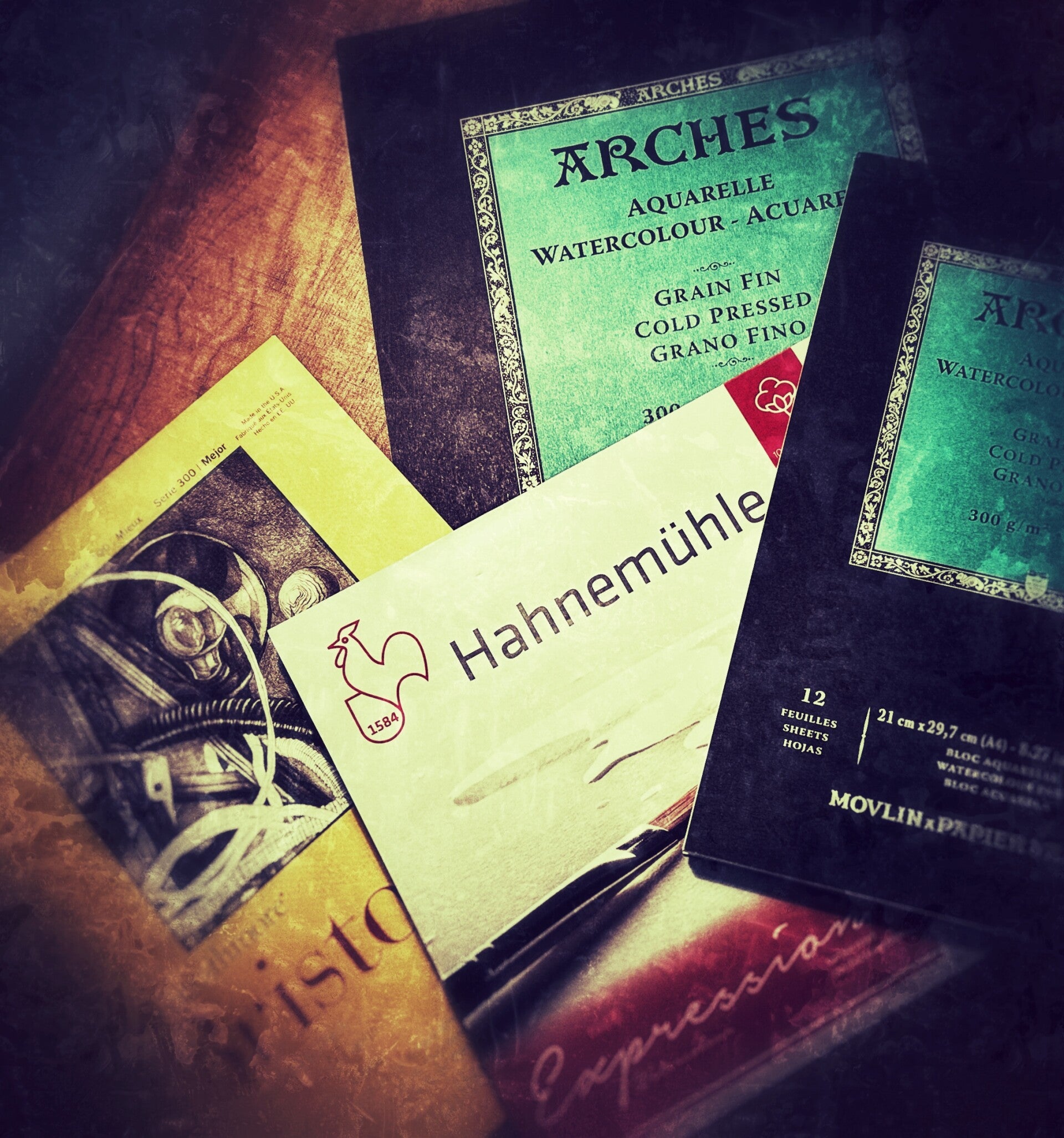
The paper I paint on makes a big difference to the way a watercolour behaves. I typically use 140lb / 300g/m² hot- or cold-pressed watercolour paper, and these days I tend to use Arches or Hahnemühle.
I particularly like working with paper blocks. These are pads of watercolour paper that are glued along all four edges, with a small unglued gap that allows individual sheets to be removed once the painting is finished. Keeping the paper secured in this way helps it stay flat while I'm painting, without the need to stretch or tape it down.
I've tried some more economically priced papers over the years, but I've found that they don't always cope as well with larger amounts of water. This is particularly noticeable when I'm working wet-on-wet, where the paper needs to handle quite a lot of moisture without buckling too much.
For pencil drawings, I usually use the Strathmore Bristol Vellum Paper Pad. It's a heavyweight 100lb / 270g/m² acid-free paper with a smooth surface that works really well for drawing and coloured pencil work.